
|
Nepal

Capital: |
Kathmandu |
Official Language: |
Nepali |
Unification: |
December 21, 1768 |
Area: |
147,181 sq km (56,827 sq mi) |
Population: |
27,133,000 (2005) |
Total GDP: |
$41.6 billion |
GDP Per Capita: |
$1,675 |
Currency: |
Rupee (NRs) |
Time Zone: |
NPT (UTC+5:45) |
Internet TLD: |
np |
Calling Code: |
+977 |
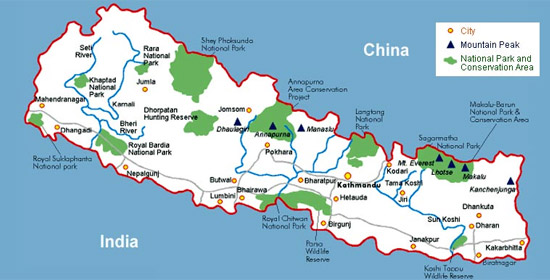
Nepal, officially known, according to its Interim Constitution, as the State of Nepal (previously known as Kingdom of Nepal) (Nepali: नेपाल [neˈpaːl] (help·info)) is a landlocked Himalayan country in South Asia. In Nepal Bhasa, Nepal is called as Nepa: (Nepal Bhasa: नेपा:). It is bordered by China (Tibet) to the north and by India (Bihar, Sikkim, Uttar Pradesh, Uttarakhand, West Bengal) to the south, east and west.
For a small territory, the Nepali landscape is uncommonly diverse, ranging from the humid Terai in the south to the lofty Himalayas in the north. Eight of the world's ten highest mountains are in Nepal, including Mount Everest. The country is famous for: tourism, trekking, hiking, camping, mountain biking, national wildlife parks, jungle safaris, river rafting, sport fishing, and its many beautiful temples and places of worship.
Kathmandu is the capital and largest city. Other main cities include Dharan, Thimi, Pokhara, Biratnagar, Lalitpur (Patan), Bhaktapur. other main towns includes Birendranagar, Bharatpur, Nepal, Siddhartanagar (Bhairahawa), Birganj (Birgunj), Butwal, Janakpur, Nepalganj (Nepalgunj), Hetauda, Damak, Dhangadhi, and Mahendranagar.
After a long and rich history, during which the region splintered and coalesced under a variety of absolute rulers, Nepal became a constitutional monarchy in 1990. However, the monarchy retained many important and ill-defined powers. This arrangement was marked by increasing instability, both in the parliament and, since 1996, in large swathes of the country that have been fought over by Maoist insurgents. The Maoists, alienated from mainstream political parties, went underground and started a guerrilla war against both monarchy and mainstream political parties. They have sought to overthrow feudal institutions, including the monarchy, and establish a Maoist state.
This led to the Nepali Civil War in which more than 15,000 people have died. After the intra-party conflict within the ruling Nepali Congress (NC) on the issue of continuation of state of emergency to deal with Maoist insurgents, then prime minister Sher Bahadur Deuba recommended the king for the dissolution of lower house seeking a fresh mandate in 2002. The king accepted his recommendation and dissolved the house as per the constitution. Later on, Deuba recommended the king for the postponement of the parliamentary election on the pretext of insecurity due to the Maoist insurgency. Then the king sacked Deuba in 2002 on the grounds of not able to hold elections and started ruling through prime ministers appointed by him. He then unilaterally declared a state of emergency early in 2005 and assumed all executive powers.
Following the 2006 democracy movement, the king agreed to relinquish the sovereign power back to the people and reinstated the dissolved House of Representatives on April 24, 2006. Using its newly acquired sovereign authority, on May 18, 2006, the newly resumed House of Representatives unanimously passed a motion to curtail the power of the king and declared Nepal a secular state. As of September, 2006, a complete rewrite of the constitution was still expected to happen in the near future.
As of July 2007, many of Nepal's new political leaders, including the former Maoist rebels, now want the monarchy abolished. The king has already lost his powers as head of state and head of the army and the government has decided to stop paying all allowances.
History
Neolithic tools found in the Kathmandu Valley indicate that people have been living in the Himalayan region for at least nine thousand years. It appears that people who were probably of Tibeto-Burman ethnicity lived in Nepal two and half thousand years ago.
One of the princes of the Shakya confederation was Siddhartha Gautama (563–483 BC), who renounced his royalty to lead an ascetic life and came to be known as the Buddha ("the one who has awakened"). By 250 BCE, the region came under the influence of the Mauryan empire of northern India, and later became a puppet state under the Gupta Dynasty in the fourth century CE. From the late fifth century CE, rulers called the Licchavis governed the area. The Licchavi dynasty went into decline in the late eighth century CE and from 879 was followed by a Newar era, although the extent of their control over the entire country is uncertain. By late eleventh century, southern Nepal came under the influence of the Chalukya Empire of southern India. After the return of Chalukya emperor Vikramāditya-VI to South India, one of his chieftains Nānyadeva established an independent state in 1091 AD which ruled over whole of North Bihar and most of southern Nepal till 1326 AD; this dynasty was famous as Karnāta. Under the Karnātas, Nepal's religious establishment changed as the kings patronised Hinduism instead of Buddhism prevailing at that time. After 1326 AD, North Bihar passed into direct control of Tughlaks of Delhi and Karnātas were confined to Nepal for next four centuries.
By the early thirteenth century, leaders were emerging whose names ended with the Sanskrit suffix malla ("wrestler"). Initially their reign was marked by upheaval, but the kings consolidated their power over the next two hundred years. By late fourteenth century, much of the country began to come under a unified rule. This unity was short-lived; in 1482 the kingdom was carved into three areas, Kathmandu, Patan, and Bhadgaon, which engaged in petty rivalry for centuries.
In 1765, the Gorkha ruler Prithvi Narayan Shah set out to unify the kingdoms, after first seeking arms and aid from Indian kings and buying the neutrality of bordering Indian kingdoms. After several bloody battles and sieges, he managed to unify Nepal three years later. However, the actual war never took place while conquering the Kathmandu Valley. Prithivi Narayan Shah was unable to defeat the powerful Newar kingdom of Kathmandu. In fact, it was during the Indra Jātrā, when all the valley citizens were celebrating the festival, Prithvi Nārāyan Shāh with his troops captured the valley, virtually without any effort. This marked the birth of the modern nation of Nepal. A dispute and subsequent war with Tibet over control of mountain passes forced Nepal to retreat and pay heavy repatriations to China, who came to Tibet's rescue. Rivalry with the British East India Company over the annexation of minor states bordering Nepal eventually led to the brief but bloody Anglo-Nepalese War (1815–16), in which Nepal defended its present-day borders but lost its territories west of the Kali River, including present day Uttarakhand state and several Punjab Hill States of present day Himachal Pradesh. The Treaty of Sugauli also ceded parts of the Terai (which formerly belonged to Bengal but were claimed by Shāh dynasty during the lawless years of late 18th century when East India Company was consolidating and extending its control) and Sikkim to the Company in exchange for Nepali autonomy.
Factionalism among the royal family led to instability after the war. In 1846, a discovered plot to overthrow Jang Bahadur, a fast-rising military leader, by the reigning queen, led to the Kot Massacre. Armed clashes between military personnel and administrators loyal to the queen led to the execution of several hundred princes and chieftains around the country. Bahadur won and founded the Rana dynasty, leading to the Rana autocracy. The king was made a titular figure, and the post of Prime Minister was made powerful and hereditary. The Ranas were staunchly pro-British, and assisted the British during the Sepoy Rebellion in 1857, and later in both World Wars. In 1923 the United Kingdom and Nepal formally signed an agreement of friendship, truth, and law, in which Nepal's independence was recognised by the UK.
In the late 1940s, emerging pro-democracy movements and political parties in Nepal were critical of the Rana autocracy. Meanwhile, China regained control of Tibet in 1950, making India keen on stability in Nepal. King Tribhuvan offered then Indian Prime Minister accession of Nepal on the condition that he be made President of India. Nehru refused but sponsored KingTribhuvan as Nepal's new king in 1951, and a new government, comprising the Nepali Congress Party. After years of power wrangling between the king and the government, the democratic experiment was dissolved in 1960, and a "partyless" panchayat system was instituted to govern Nepal. In 1990, the "Jana Andolan" (People's) Movement forced the monarchy to accept constitutional reforms and establish a multiparty parliament in May 1991.[5] Krishna Prasad Bhattarai became the Prime Minister, drafted a new Constitution and carried out the democratic elections for the parliament. The Nepali Congress Party won the country's first democratic elections, with Girija Prasad Koirala becoming prime minister.
Geography
Nepal is of roughly trapezoidal shape, 800 kilometres (500 mi) long and 200 kilometres (125 mi) wide, with an area of 147,181 square kilometres (56,827 sq mi). Nepal is commonly divided into three physiographic areas: the Mountain, Hill, and Terai Regions. These ecological belts run east-west and are bisected by Nepal's major river systems. Nepal is roughly the same size as the US state of Arkansas.
The Madhesi Plains bordering India are part of the northern rim of the Indo-Gangetic plains. They were formed and are fed by three major rivers: the Kosi, the Narayani (India's Gandak River), and the Karnali. This region has a hot, humid climate.
The Hill Region (Pahad) abuts the mountains and varies from 1,000 to 4,000 metres (3,300–13,125 ft) in altitude. Two low mountain ranges, the Mahabharat Lekh and Shiwalik Range (also called the Churia Range) dominate the region. The hilly belt includes the Kathmandu Valley, the country's most fertile and urbanised area. Unlike the valleysCalled Inner Tarai (Bhitri Tarai Uptyaka) elevations above 2,500 metres (8,200 ft) are sparsely populated.
The Mountain Region contains the highest region in the world. The world's highest mountain, Mount Everest (Sagarmatha in Nepali) at 8,850 metres (29,035 ft) is located on the border with China. Seven more of the world's fourteen highest mountains are located in Nepal: Lhotse, Makalu, Cho Oyu, Kanchenjunga, Dhaulagiri, Annapurna and Manaslu. Deforestation is a major problem in all regions, with resulting erosion and degradation of ecosystems.
Nepal has five climatic zones, broadly corresponding to altitude. The tropical and subtropical zones lie below 1,200 metres (3,940 ft), the temperate zone 1,200 to 2,400 metres (3,900–7,875 ft), the cold zone 2,400 to 3,600 metres (7,875–11,800 ft), the subarctic zone 3,600 to 4,400 metres (11,800–14,400 ft), and the Arctic zone above 4,400 metres (14,400 ft). Nepal experiences five seasons: summer, monsoon, autumn, winter and spring. The Himalaya blocks cold winds from Central Asia in winter, and forms the northern limit of the monsoon wind patterns.
Although Nepal shares no boundary with Bangladesh, the two countries are separated by a narrow strip of land about 21 kilometre (13 mi) wide, called the Chicken's Neck. Efforts are underway to make this area a free-trade zone.
Situated in the Great Himalayan Range in Northern part of Nepal, Mount Everest is the tallest mountain in the world. Technically, the south-east ridge on the Nepali side of the mountain is easier to climb, so most climbers travel to Everest through Nepal. The Annapurna mountain range also lies in Nepal.
Zones, Districts and Regions
Nepal is divided into 14 zones and 75 districts, grouped into 5 development regions. Each district is headed by a fixed chief district officer responsible for maintaining law and order and coordinating the work of field agencies of the various government ministries.
The 14 zones are:
- Bagmati
- Bheri
- Dhawalagiri
- Gandaki
- Janakpur
- Karnali
- Koshi
- Lumbini
- Mahakali
- Mechi
- Narayani
- Rapti
- Sagarmatha
- Seti
Culture
Nepali culture is very similar to the cultures of neighbouring Tibet and India. The culture of Northern mountainous belt is similar to that of Tibetian culture; however most of the part is influenced by Hindu culture. There are similarities in clothing, language and food. A typical Nepali meal is dal-bhat - boiled dal served with rice, vegetables and spicy relish. This is consumed twice daily, once in the morning and again after sunset. Between these main meals, snacks such as chiura (beaten rice) and tea are consumed. Meat, eggs, and fish are considered a treat. In the mountainous region the staple diet is based on wheat, maize, millet and potatoes. Millet-based alcoholic drinks known as Tongba and other cereal based alcohol are popular, including chhaang and the distilled rakshi.
Traditional Nepali folklore retains a strong influence in society and its stories are widely acted out in dance and music. The culture of different ethnic groups is rich in their own ways.
Newar Culture
The Newar culture is the historic culture of Kathmandu. Newar culture is the most distinct and most preserved culture of Nepal, and definitely the richest culture of Nepal. Most of UNESCO World Heritage site in Nepal are were made by Newars and are existing example of rich Newar cultural heritage. Examples include Kathmandu Durbar Square, Lalitpur Durbar Square, Bhaktapur Durbar Square, Swoyembhunath, Changunarayan and Bhaudanath.
The Newar community enjoys its own special cuisine (Newar cuisine), apparels, architecture (Newar Architecture), language (Nepal Bhasa), traditions and festivals (Newa Festival). Newar people are well known for masked dance that tell stories of the gods and heroes. Lakhey is the most popular traditional dance in the entire country. The associated music is percussion-based, sometimes with flutes or shawm accompanying the intense, nasal vocal lines. In other culture, the sarangi, a four-stringed, hand-carved instrument is usually played by wandering minstrels.
Other Aspects of Nepalese Culture
Popular musical styles are a variety of pop, religious and folk music, among other styles. Since the sixties, Nepali rock or rock music, sung to Nepali lyrics, has slowly gained some popularity among a subset of youth, particularly in the Kathmandu Valley. Nepalese hip hop and Nepali reggae have developed in urban areas with the advent of the music video industry. Heavy metal bands also have some following in areas such as Kathmandu. However, these are minority genres; the predominant contemporary musical form is Hindi pop and Nepali pop based on Hindi models, which is popular throughout the country, including the rural areas where the majority of the population lives. Musical genres from Tibet and India have had a strong influence on traditional Nepali music. Women, even of the musician castes, are less likely than men to play music, except in specific situations such as traditional all-female wedding parties.
Football is the most popular sport, followed by cricket and kabaddi. The Martyrs Memorial Football League is the national football championship.
Television was only introduced to Nepal in the 1980s. Currently there are six television broadcasting channels: Nepal Television - the national television channel; NTV 2 Metro - a city channel owned by the government; and four private channels - Kantipur Television, Image Channel, Channel Nepal and Nepal 1. Also many other networks, particularly those that originate in India, are available via satellite dishes, although lack of electricity makes this difficult. Radio is listened to throughout the kingdom; as of 2000, there were twelve radio stations, and in 2006–07 number grew to 56+ Radio stations. Among them most are local FM radio stations, heard in limited range of this hilly nation. However few FMs like Kantipur FM, Image FM are heard over wide range by the help of repeater stations.
The Nepali year Bikram Samwat begins in mid-April and is divided into twelve months. Saturday is the official weekly day of rest. Main holidays include the National Day (birthday of the late king Tribhuvan) December 28, Prithvi Jayanti, (January 11), and Martyr's Day (February 18) and a mix of Hindu and Buddhist festivals such as Teej, Dashai in autumn, and Tihar late autumn.
Most marriages are arranged, and divorce is rare. Polygamy is banned by law; relatively isolated tribes in the north, such as the Dolpo, practise polyandry. The various groups of Nepal have a rich tradition of ceremonies, such as nwaran (the christening of a child), Pasni, the day a child is first fed rice, and bratabandha (the penance ceremony) and gupha for prepubescent boys and girls, respectively. In Newari culture,bel bibaha, preadolescent girls are "married" to the bel fruit tree, ensuring that the girl becomes and remains fertile.
Most houses in rural Nepal are made up of a tight bamboo framework with mud and cow-dung walls. These dwellings remain cool in summers and retain warmth in the winter. Dwellings at higher altitudes are mostly timber-based.
Chhaupadi is a custom, widely practiced in some areas, in which women don't enter the kitchen or engage in particular chores during menstruation because they are considered impure.
Source: Wikipedia |